Peri-Urbanization, Environmental Noise Exposure (dB Lden) & Cardiovascular Epidemiology
Environmental noise is no longer classified merely as an auditory nuisance. Across Europe and rapidly urbanizing Asian and South Asian metropolitan corridors, chronic transportation and peri-urban acoustic exposure ranks among the top environmental hazards for ischemic heart disease (IHD), hypertension, stroke, metabolic dysfunction, and cortical sleep fragmentation.
Chronic environmental noise from road traffic, railways, and aircraft activates the hypothalamic-pituitary-adrenal (HPA) axis and sympathetic nervous system during sleep, elevating nocturnal cortisol, endothelial oxidative stress, and blood pressure. The World Health Organization (WHO) strongly recommends keeping road traffic noise below 53 dB Lden (day-evening-night) and 45 dB Lnight; above 53 dB Lden, each 10 dB increase raises ischemic heart disease incidence by 8% (RR 1.08).
#scientific-9-946 · #archive-monograph): This monograph preserves and updates the historical MedRead open-access study "Peri-Urbanization and Noise Exposure: A Strategic Study in Quetta, Pakistan" (Zia MA, et al., 2020; legacy paths /uploads/article_pdf/9/scientific_9_946_20032020075144.pdf and /uploads/article_pdf/90/scientific_90_959_13042020124654.pdf), cited by Heriot-Watt University (hw.ac.uk) and Scientific Research Publishing (scirp.org).
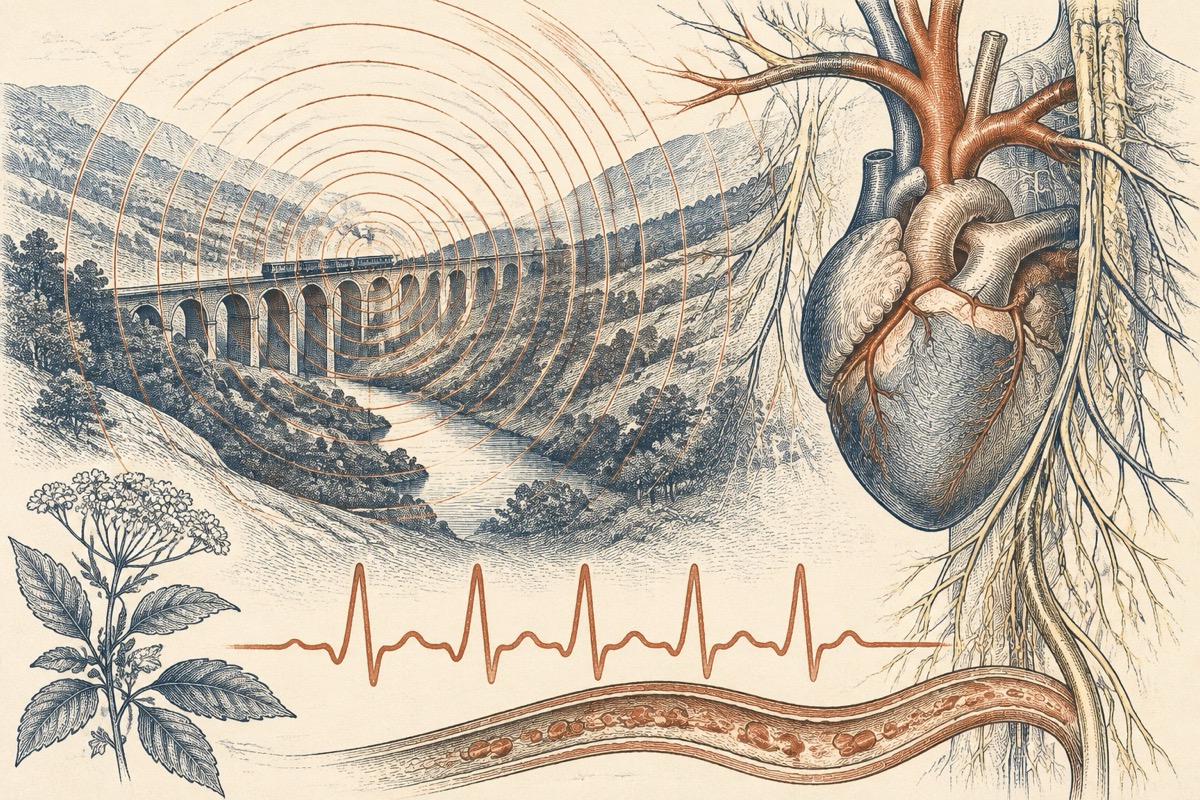
What Decibel Level of Traffic Noise Increases Cardiovascular Risk According to WHO?
Comparing the 2018 World Health Organization Environmental Noise Guidelines against 2020-2026 peri-urban field measurements and European Environment Agency (EEA) cardiovascular risk models.
| Acoustic Source / Context | WHO Daytime-Weighted Limit (Lden) | WHO Nighttime Sleep Limit (Lnight) | Cardiovascular & Sleep Risk per +10 dB | GRADE Evidence Rating |
|---|---|---|---|---|
| Road Traffic Noise Highways, arterial avenues |
53 dB Lden Strong recommendation |
45 dB Lnight Strong recommendation |
RR 1.08 (95% CI: 1.01 to 1.15) for ischemic heart disease incidence starting at 53 dB Lden; high sleep disturbance above 45 dB. | HIGH CERTAINTY (IHD) |
| Railway Noise Freight & high-speed rail corridors |
54 dB Lden Strong recommendation |
44 dB Lnight Strong recommendation |
Cortical awakening & vascular stiffness: Nocturnal freight pass-bys trigger autonomic heart-rate surges even without conscious recall. | MODERATE CERTAINTY |
| Aircraft Noise Airport flight paths |
45 dB Lden Strong recommendation |
40 dB Lnight Strong recommendation |
RR 1.09 per +10 dB for IHD in pooled cohorts; acute nighttime aircraft noise impairs brachial artery flow-mediated dilation (FMD). | MODERATE CERTAINTY |
| Peri-Urban Unplanned Expansion MedRead Archive MS-946 / MS-959 (Quetta Cohort, 2020) |
Observed: 72 to 86 dB(A) Exceeds WHO by +19 to +33 dB |
Observed: 61 to 70 dB(A) Exceeds WHO by +16 to +25 dB |
Severe cumulative exposure: Mixed residential-commercial encroachments and two-stroke/diesel transit corridors drive chronic hypertension and sleep debt. | ARCHIVAL MONOGRAPH |
Primary sources: WHO Environmental Noise Guidelines for the European Region (2018) · Nature Reviews Cardiology 2024 (Münzel et al., Transportation Noise & CV Risk) · Journal of Exposure Science & Environmental Epidemiology 2024.
Dose-Response Curve: Road Traffic Noise (dB Lden) vs. Relative Risk of Ischemic Heart Disease (IHD)
Based on WHO systematic review meta-analysis (Kempen et al. / Münzel et al.): risk inflection begins near 50-53 dB Lden and scales log-linearly at RR 1.08 per +10 dB.
Archival Monograph Concordance: Zia MA et al. (2020) & Pathophysiological Mechanism
In the 2020 MedRead Journal of Environmental Science monograph (scientific_9_946 / scientific_90_959), researchers evaluated rapid peri-urban expansion in Quetta, Pakistan, where unplanned residential growth along high-density transit corridors exposed households to daytime sound pressure levels of 72 to 86 dB(A) and nighttime levels above 60 dB(A). Alongside parallel mathematical modeling work archived in the 2020 MedRead series (cited by Heriot-Watt University), this dataset remains a benchmark for developing-world urban acoustics.
How Nighttime Noise Damages Arteries While You Are Asleep
Per Babisch's Noise Reaction Model and subsequent translational human studies by Münzel and Daiber (2020-2025), non-auditory cardiovascular damage occurs primarily during sleep (Lnight > 45 dB):
- Subcortical Amygdala Activation: Even when a sleeping resident does not consciously wake up, acoustic peaks above 45-50 dB signal the auditory cortex and amygdala, triggering sympathetic catecholamine release and HPA-axis cortisol elevation.
- Endothelial eNOS Uncoupling: Elevated angiotensin-II and NADPH oxidase activity generate vascular superoxide, uncoupling endothelial nitric oxide synthase (eNOS) and inducing nocturnal non-dipping hypertension.
- Co-Exposure Confounding Adjustment:A key methodological question in environmental epidemiology is whether traffic noise is merely a proxy for traffic air pollution (PM2.5 and NO2). Multi-exposure cohorts (such as the Swiss SAPALDIA and Danish Diet, Cancer and Health studies) proved that road and aircraft noise remain independent predictors of myocardial infarction and stroke after adjusting for PM2.5 and NO2.
Frequently Asked Methodological & Clinical Questions
Plain-language answers grounded in CONSORT, GRADE, WHO guidelines, and per-1,000 absolute outcome arithmetic.
What do Lden and Lnight mean in WHO noise guidelines?
Lden (day-evening-night level) is the 24-hour average sound level in decibels (dB) with a +5 dB penalty added to evening hours (19:00-23:00) and a +10 dB penalty added to night hours (23:00-07:00) to reflect heightened human physiological sensitivity to evening and nocturnal noise. Lnight is the unpenalized average outdoor sound level during the 8-hour night period.
Does wearing earplugs or upgrading windows reduce cardiovascular risk from traffic noise?
Yes. Epidemiological studies analyzing bedroom orientation and window sound insulation show that the cardiovascular risk of road traffic noise tracks indoor sleeping exposure rather than facade exposure alone. Moving the bedroom to the quiet side of a building or installing acoustic double-glazed windows reduces nocturnal sympathetic activation and blood pressure surges.
Source: European Heart Journal (Münzel et al., Noise Mitigation)
Where can I find the citation details for the 2020 MedRead peri-urban noise study?
The 2020 study by Zia MA et al., 'Peri-Urbanization and Noise Exposure: A Strategic Study in Quetta, Pakistan,' originally hosted at /uploads/article_pdf/90/scientific_90_959_13042020124654.pdf and /uploads/article_pdf/9/scientific_9_946_20032020075144.pdf, is permanently indexed on this page (#scientific-9-946) and in our 2019-2022 Archival Concordance.